Showing posts with label disneyland abu Dhabi. Show all posts

May 30, 2026

The Amazing Disappearing Article That's Worth Reading Again: Disney CEO Fumbles Entry to China

Here's an article that appeared- and then was quickly removed- from the Huffington Post. A powerful piece that criticized Robert Iger and the Walt Disney Company's plan for their entry into the Chinese market, and its potential effect on Shanghai Disneyland. It must have angered him so much that Iger used his wife's influence to have it yanked. I hate that kind of corporate or governmental power play!  So, here it is below, courtesy Google.  Thanks to the WDWMagic Boards where the article was originally resurrected. What will happen to Disneyland Abu Dhabi? Will there be lessons learned from the past?

-------------

Sorry Mickey, they're just not that into you. Minnie, you either.
For that matter, you can take the whole stable -- the "Fab Five" of Walt Disney's animated creations -- and, despite a media machine that churns a very different story, China has largely been a land where the fabled wishes, dreams and magic of the Walt Disney Company and its brand have virtually no connection with the consumer. As valued as that consumer is in the economic theater of globalism, the iconic brand synonymous with America has little appeal and less traction among the newly seated audience in the Chinese mainland.

To its 'vanilla on toothpaste' helmsman, Robert A. "Bob" Iger, who has shown himself to be an able cobbler of assets but a less than visionary leader of the media colossus that is the Walt Disney Company, this troubling if known and growing headwind threatens to undermine the content-heavy but culturally aloof purveyor of demographically unshackled product. For in his zeal to expand its library of content, Bob Iger has drop-kicked the Disney moniker to enter new and expanding marketplaces only to position a product that runs well afar of the expectation of the Disney bounce.

In so doing, the once unrivaled status of the Disney brand has become a catch-all for entertainment and its associated byproducts that are increasingly a strange and sometimes conflicted ragbag of franchised acquisitions presented as some sort of media mélange for all ages and all palates. Or, as John Dreyer, the longtime and immediate past head of corporate communications for the Walt Disney Company, said upon the publication of the column Disney CEO Readies Magic Carpet for Exit, "Disney losing its Disney way."
With the company making its grandest play for a market that dwarfs all others, Disney has found itself adrift in a crisis of identity that breaches the foundation of the castle upon which an empire was built. For as turrets were raised, wings were added and a moat of meticulously positioned whimsy was filled in to expand the Disney footprint, something that looks decidedly more pedestrian than the fantastical inspiration for one of the world's most coveted brands has emerged.
Leverage has become the arch of entry into the Disney-verse, while the brand has been marginalized into a holding vehicle for assets that are worth more separately than that vested in the castle itself.

As Mr. Iger said at the 2013 Fortune Global Forum held in Chengdu:
I think the first thing you have to do is you have to obviously be aware of what your most significant brand attributes are. What makes your brand your brand? Why is it great? You have to focus on quality and on those attributes that, again, created the value in the first place. You can't look to cut corners. You can't look to make something with your brand on it that's any cheaper simply because it's going into a market that may not be able to afford it the way another market may have. You can't compromise in that regard. So it starts with what I'll call quality and a respect for an allegiance to the very brand attributes that created the value in the first place.

Now, considering Shanghai Disney is preparing to make its 2016 debut as Disney's first foray into the renminbi rich Chinese mainland after a less than stellar arrival in the former British colony of Hong Kong in 2005, there are lessons aplenty to learn from that delayed embrace and the long stalled entry into the single largest consumer market on offer to the world -- the whole of China. 


Under Mr. Iger's stewarding, Disney has partnered with the Shanghai Shendi Group, an umbrella name placed on a panoply of government-owned companies created to facilitate Western investment as a massive anti-graft campaign is just now rattling Beijing and beyond, to introduce a Disney 'branded' park to those consumers. A flag in the ground for Disney. A flag that has been in the works since the prime of Michael Eisner's reign at Disney and one that nearly collapsed entirely by the summer of 2006.


Indeed, Mr. Iger had to leave the annual Herb Allen retreat for media moguls, tech tycoons and other scripters of society in Sun Valley for an unscheduled trip to Shanghai that day in 2006, scrambling to save face and leading to a denouement worthy of great scrutiny by any company -- especially those entities whose trade is in intellectual property -- wanting to enter China.

Or, as Dalian Wanda Group Chairman Wang Jianlin, whose real estate and entertainment empire is building its North American headquarters adjacent to the Beverly Hilton at 9900 Wilshire Boulevard in Beverly Hills, said on the same panel at the Fortune Global Forum:

[W]e have so many Western companies in China, but you cannot simply replicate the Western ideas and philosophies in China. They need to adapt to the Chinese realities... So for Fortune 500 companies in China it's very important, it's imperative for them to learn traditional culture in China and how is it interrelated with the modern business culture.

Curiously though, the world beyond the berm is told the 330 million or so Chinese within a three-hour trip to the site on the other side of Shanghai's Pudong International Airport cannot wait to queue up for a boat ride on "It's a small world"or whatever Disney is offering up for its reported $5.5 billion marker. As, no, there will apparently be no attraction of that name at Shanghai Disneyland.

Not in China. Not in a country where Mickey, Minne and the rest of the gang are barely known. In a country where Disney might as well be Smith or Jones or Johnson. Well, maybe not that last one as Johnson & Johnson is actually a reasonably well-known brand throughout China.

The Walt Disney Company has a history of stumbling if not outright tumbling in its efforts to export Disney's brand of Americana. For reference, look no further than Euro Disney -- now known as Disneyland Paris -- and Hong Kong Disneyland. Of the latter, it is worth note that Disney has been known to Hongkongers from the early days of the Disney Brothers Cartoon Studio. Yet, to this day, with a direct link by MTR line to points throughout Hong Kong, Disney is barely able to keep up with the brand devoid, geographically hemmed in and animal exhibit heavy Ocean Park in Aberdeen.

Over lunch earlier this month at Neptune's in the Grand Aquarium, Ocean Park Hong Kong CEO Tom Mehrmann, who began his career as a street sweeper at Knott's Berry Farm just up the road from Walt's original Disneyland, said, "Disney still has to explain to some of its guests exactly what a 'Disney Park' is. We don't have that problem."

To further illustrate this point, visit Disney's outpost on Lantau, a parcel of reclaimed land near Hong Kong International Airport, and you will notice a different Disney. Some call it 'Disney-lite'. Others refer to it as 'McKingdom'. Regardless, there is a definite feel of a diminished product -- of a diminished brand -- on stage for the public's consumption.

For, on a spit of land with an audience topping seven million attached by subway line having a familiarity and a kinship with the West, sits the real experiment of Disney's entry into the Chinese market. And there, on a recent day, at a performance of The Lion King in a theater designed for Disney's Animal Kingdom in Orlando dropped into the Walt Disney Company's first Disney branded park in China, the actors sought to lead the audience in a rendition of the hit tune from this classic of Disney's second golden age of animation: Hakuna Matata.

Hakuna Matata. 
What a wonderful phrase. 
Hakuna matata. 
Ain't no passing craze.
It means no worries. 
For the rest of your days. 
It's a problem free philosophy.
Hakuna matata.
Arms raised high in the air, cast members -- on stage and off -- encouraged the capacity crowd to sing the infectious chorus. With lyrics blasting through the speakers and flashing on screens in the theater, they sought a simple singalong to the catchy and commercial hit written by Elton John and Tim Rice. Unmoved, the audience sat stone-faced. Child and adult alike.

Considering most individuals reading this are likely humming the tune or hearing it play as part of the soundtrack of their lives, that speaks poorly of Disney's penetration into the far less foreign landscape of Hong Kong. As for Shanghai, Mr. Iger continued on at the conference in Chengdu:
We're a brand that is viewed as good for me and good for my family. There are values to the Disney brand and what it stands for that have interested people all over the world. But, it's very, very important that while we bring Disney to a market we make sure that in that market it feels like, for instance, China's Disney.

In leaving the park on that recent evening, the dressed by and for Disney MTR cars filled with tired visitors exposed to, saturated in, that which is the Disney Parks experience offered up in Hong Kong. Looking to the left, to the right, all around, not one visitor had that uniquely American rite of passage positioned upon their head. Mickey ears. Not one.
And, in the second largest market for its product and the largest consumer market on the planet, Disney's Frozen, the highest grossing animated film ever having delivered over $1.27 billion in ticket sales and the fifth-highest grossing film of all time, earned little more than $48 million. Less than four percent of its global box office.
Welcome to China, Bob.


Gary Snyder is a member of the Redstone family, whose company, National Amusements, owns Viacom and CBS, among other media assets. He is an advisor on Western media and culture to China.

April 13, 2026

Disneyland Resort Introduces The Master Plan

It seems everyone who is anyone has been talking about Disneyland Forward and what is really on line post Coco, Avatar / Pandora, and the Avenger's Campus expansion. (Notice Walt's park is left out of much of the discussion. Hmmm.) Almost immediately, I remembered  the original and perhaps grander plans for Anaheim's second Disney park- long before the suits under Michael Eisner (with Robert Iger, by the way. ) cut the very heart out of the expansion project once the 2 billion dollar amount to build it was realized. Mind you, this was just for the park, and it did not include any resort hotels or what would become Downtown Disney. (I wonder where Josh D'Amaro was at this point in his Disney career. Anyone know?)


As we all know by now, in its place, Disney built the much cheaper and ultimately disappointing California Adventure 1.0- a Disney park disaster equivalent to Disney's quick and dirty direct to video animated classic sequels. Simply said, the park stunk. For me, the first visit anticipation of a new Disney park was ruined by the final product- and I was not alone in that assessment.

Fans knew it stunk, and deep down, I believe suits knew it as well- even if the folks working with them and the Imagineers weren't bold enough to stand up and say so. The hip and edgy contrived sibling was a test tube baby created by sharp marketing folks loaded up with charts, facts, and figures. In other words, it was a heartless disaster playing on the loyalty of Disney fans for a quick buck. (Want to see just how cheap the first version was? Go to my multi-part series here to see the concept art for the original park. It's truly "Bargain Basement Imagineering" at its worst / best. You'll be shocked at what the suits passed off as a Disney quality experience.) As we all know, eventually, the suits under Iger admitted the failure and approved a huge investment to make the park one which was no longer an embarrassment. 

In contrast to the opening day version, I love California Adventure 2.0. Mostly. The whole Twilight Zone Tower of Terror into Guardians of the Galaxy mishap aside, I see it becoming a pretty wonderful and complete Disney worthy park in another half decade or so. Oh wait! There's also the Pixar Pier mess, and the cheap Big Hero 6 overlay. Well, going forward, once the Disney Imagineers continue to add great attractions as well as remove the remnants of what was first created, seen mostly in the Hollywood Land, the park should look terrific and be filled with unique must-see adventures. Maybe. Yet, along with many other hard core Disney park fans, I've never forgotten the park we should have seen built: Westcot.

Let's now dig into what surely would have been an instant fan favorite as well as bring even more lucrative park festivals to the West Coast.   

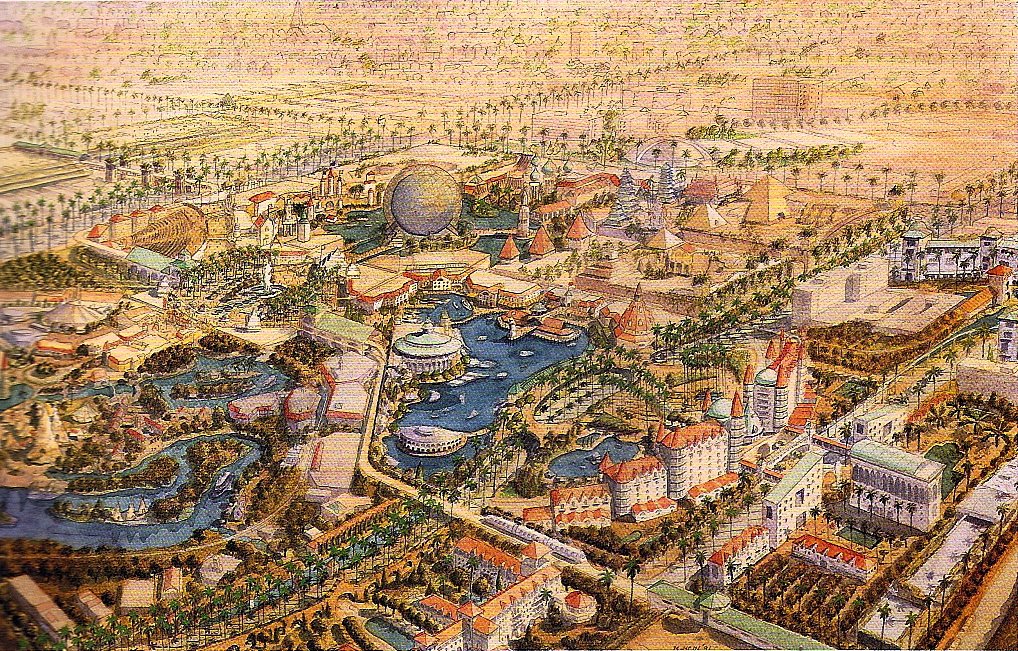
This piece highlights all of the planned expansion.
Lots to see, so click on it for the largest size.

Could they pull off an Epcot type park in California? In Florida, the Imagineers had "the blessing of size". This clearly was not the case in overly crowded, slam packed Southern California, particularly in the neighborhood right around Disneyland. The great enduring success of the original Disney kingdom brought with it lots of cheap motels and services, fast food restaurants, and traffic that overwhelmed the streets. Available land was snapped up by investors as soon as the new park was a huge success. This meant almost immediately, the area became a blistering eyesore Disney and the City of Anaheim tried to remedy ever since.  

When trying to expand Disneyland, it speaks to the ingenuity of the greatest Imagineers that they embraced these tight space restrictions as a design challenge, using it to spark creativity towards a greater goal. This is the exact thinking encouraged by Walt himself. It all makes Disneyland just so charming. The park is full of attractions, shops, and restaurants in layers to be discovered all around by park visitors. 

In Florida, the extra land certainly allowed wider walkways and larger gardens, easing guest flow and making for a showier presentation, but it also created a park environment where large, iconic buildings almost seem to float relationally disconnected from one other. All that space became a huge plus for a park design as ambitious as EPCOT Center, but in contrast, it became a crutch of sorts, a pretty serious detriment when it came to the overall design and feel of the Magic Kingdom.  

Original site plan model for the Anaheim expansion project.

The site plan map. 
Take notice of the original plan for the lake.

There was no doubt in anyone's mind that Disney in California had to expand to accommodate its ever increasing crowds. How do you build an all encompassing Downtown Disney, new hotels, and a brand new theme park with so little room? That "blessing of size" didn't exist in Anaheim, so the key question had to be asked: Could that fairly compact slice of land available for the second EPCOT type park build out actually become an advantage? Clearly, that's up for debate as Westcot was never built, but I would say unequivocally, the answer is yes. As with the expansion to "Walt's park", the tight space limitations for Westcot ultimately demanded a very unique and exciting version of Florida's second Disney theme park.

By necessity, the design of this park would have to be different than its older brother, and it was. Anytime people look backwards, things could be done better. So it was this time as well. The Imagineers had learned from the past as well, listening to feedback given as EPCOT Center had been around a few years. The issues regarding families with young children and those seeking thrill rides would be addressed this time around. Not with a character infusion, however. The whole park would feel fresh and different- and in at least one very significant way that would make today's money hungry suits at Walt Disney Company wish they would have followed through and built it. I won't tell you what that is right now, but trust me, you'll surely recognize it when you read it.


As seen above, this wouldn't be the first time
Disney Imagineers considered a golden hued
Spaceship Earth.

As with EPCOT Center, the Imagineers planned the new Anaheim park would include two main segments blended together. Future World would be complete with a new golden version of the iconic Spaceship Earth- here called Spacestation Earth. The new name and color of the icon wouldn't be the only twist from the original. This time, the giant 300 foot sphere would be in the center of a small lake with the international focused World Showcase regions of the park encircling it. 

Not only would this huge building be the centerpiece of the park, it would be seen from all over Orange County- something that didn't occur with Disneyland's larger structures. Aside from the viewing the Matterhorn, no structure could be seen from outside the park. This grand vision for Westcot's icon would become a focal point of a bigger battle with the city of Anaheim, its residents, and the Company all waging war against each other with different opinions and angles on what should and shouldn't be built. In fact, Disney also played the city of Anaheim against the city of Long Beach with its plan for the proposed California version of Tokyo's rightly acclaimed DisneySea park... but that's another story to be told at a different time.

A vision in gold.

Many local residents and Anaheim government officials weren't too thrilled with this design choice as it was viewed by them as the company celebrating and showcasing its dominance over the city and the surrounding neighborhoods. Nightly fireworks were an issue for some already. This would be too much Disney in their face for them to handle.

The residents of the surrounding neighborhood fought against Disney's plans, with the giant golden spherical icon only providing a focal point for the community build its case. The epic and much publicized battle eventually assisted the Walt Disney Company in ditching their more expensive plans- something they were happy to do after overbuilding hotels at Disneyland Paris- to build a different kind, a cheaper kind, of theme park. And the city got Disney California Adventure instead.

Westcot's icon would have dominated the skyline, but on the plus side, the glittering, golden sphere would have been an instantly recognizable advertisement for the larger than life new park. In an effort to address those concerns as well as the growing building costs, the sphere was later replaced by a large spire. Certainly less inspiring and definitely less majestic, the spire was more in line with what both sides truly wanted. Cheap, quick, easy to build. In other words, it reeked of the Sun icon for California Adventure 1.0. (That park once had a spire proposed as well!) But back to the Westcot and the attractions that were supposed to be...


More ideas on how to make this new Spaceship Earth unique.

Naturally, this portion of the park would highlight the future. The prevailing idea here was to build a park that glanced at the future but intentionally would be constructed without shows or attractions that had to be updated to represent an ever-changing world. Again learning from the past, the Imagineers had already discovered how difficult it was keeping tomorrow in Tomorrowland. Or Future World in Epcot.

In this new Epcot, there were Future World type pavilions to be found, but the topics were generic in nature: the Land, Living, and Science, making it easier to present an entertainment focused approach. More difficult topics such as energy and transportation have been left behind in favor of considerably lighter, fantasy-based fare. Some attractions and Future World environments were based on ideas once proposed but discarded for Florida, particularly those of Imagineer Tony Baxter. This included the content of the original glass based towers for The Land. (I've got it somewhere on the blog but can't find it. The man has always proposed great projects! Look at his unbuilt concept art for Fantasyland here.)

Additionally, in stark contrast to what was built in Florida, California's forward looking area would view what was to come through much more whimsical eyes- including those of Figment and Dreamfinder in a newer take on the classic Journey into Imagination. For good measure, the Imagineers would also toss in a shimmering version of Horizons and a fresh presentation of the Wonders of Life. Now looking backward, those beloved signature attractions would be very welcome in California where the Disney theme park fanbase is much stronger, more nostalgic, and more receptive to old school attractions.

Beautiful, golden, and expensive.

"FuturePort" is what the concept art named it.

From the base of the park's centerpiece was Ventureport, guests could explore these attractions and smaller exhibits, but it was also the main departure point into a newly reimagined World Showcase, now known as the Four Corners of the World.

A spire in place of Spaceship Earth.

The nighttime view.

The initial success of EPCOT Center gave the Imagineers a chance to objectively look at the park from a constantly changing guest dynamic. The original thought in design was that adult park visitors would be the core audience. In World Showcase, guests would be enthralled with the opportunity to explore other cultures through food and drink and travelogue films without the need for Disney character meet and greets or a large number of theme park rides. As Disney looked at the facts, they soon discovered families with younger kids were almost as much a part of the park's guest roster as the Magic Kingdom. This meant kids were more easily bored with watching travelogues than adults and need something else. More rides - including those for children as well as some thrill rides- were part of the order for the new Westcot.

                         
Latin America in World Showcase.

Space restrictions also forced a new look at this portion of the park, and in the process, something entirely new and interesting came together. Instead of individual countries being represented, now they were clustered together into continents. There's pros and cons to this newer approach. The pros are fairly easy to describe: more countries can be represented within a smaller space. The cons? It's not as easy to get "lost" in an individual country, feeling the full depth of the place.

One of the very best aspects of World Showcase in Epcot is the ability immerse deeply in an experience. Getting lost in the back streets of Morocco, the quiet hidden nooks of France and Japan or the lush backwoods of Canada would be much more difficult to accomplish at Westcot. There would always be new cultural icons acting as lures to the next area, and the inherent risk of sensory oversaturation would be a concern. 

According to Imagineer Tony Baxter, who once gave a lengthy talk on the project, (look here for the transcript), it was more than a best of recreation of what worked well in Florida. Much more. One of the most exciting parts of the Four Corners was a major attraction called The World Cruise. Imagine getting on board a boat at 5 various ports of the world and experiencing a bit of culture, mystery and romance on a 45 (yes, 45!) minute journey on the park's waterways. This excited me, as Disney boat ride attractions tend to be my favorites in any park, be it Pirates of the Caribbean, It's A Small World and the watercraft in the castle parks, El Rio Del Tiempo in Epcot, and Na'vi River Journey at Disney's Animal Kingdom. (Wow- Could this be a hidden reason why Disney's Hollywood Studios is my least favorite Disney park in Florida? Never thought of that before! Bring on Coco for California Adventure- can't wait!)

Back to the World Cruise. Along the journey in between ports, boats would enter a series of colorful, rich, indoor panoramas talking about the culture and history of the continents explored. Think about the show scenes of Spaceship Earth, the now-defunct World of Motion, mixing in Audio-Animatronic actors depicting historical events and references important to that society. The epic nature of this attraction cannot be overstated. This was Disney Imagineering going above and beyond what they had already accomplished at Walt Disney World. It'd be something unique and compelling. 

All of Asia in one easy to access area.

Red Square and Paris next door to each other- only in Westcot- 
or in Putin's dreams.

Kids rides would be cleverly incorporated into the park's landscape via smaller "B" and "C Ticket"level attractions. Travelogues to highlight regions of the world? Of course, those would make the cut. 

What about thrill rides for the teens? A roller coaster in the form of a slinking dragon moving through lovely Chinese mountains was on the agenda. That would scratch that itch. Then, they tossed in handfuls of smaller exhibits to be explored, numerous and varied artists providing traditional cultural entertainment, smartly designed children's play areas, and a simulator attraction or two. You now get the idea of what the Imagineers planned to fill out the park's roster of major "E Ticket" type attractions. This clearly re-Imagined version of World Showcase wouldn't be met by the cries of "There's too few rides, no thrills, and nothing for my kids to do!" There was even talk of an attraction or two based on the three major religions of the world in their own version of the Middle East- complete with a reflective "peace garden". This is something Disney wouldn't have the guts to do now in our politically correct but extremist charged, global neighborhood. Even if they pick us this park idea for the previous strawberry field acreage, that peace garden would never see the light of day.

There was one other discovery to be found at Westcot- one I found delightful once I got past the cash grab aspect - was the ability to stay overnight in the country or region of your choice.(Yes, there it is. I know you see it now!) Popular buildings posing as landmarks during the day (and blocking out the city of Anaheim just beyond the park) would not just house new attractions, gift shops, and pricy restaurants, they would also be the home to expensive premium hotel rooms, making this the first Disney park to truly allow guests to stay within it. 

I'll close this article with some back and white pieces of rarely seen concept art for the Westcot park created by Conceptual Design Group in Irvine, (now in Trabuco Canyon) California. (One more is at the top of this post.) These tell only part of the Westcot story, but it's a good place to end.


Would the brand new Westcot have been the hit Disney needed in order to successfully expand the Disneyland Resort and keep the cash flow moving? Without a doubt, but Michael Eisner and his suits (including Robert Iger) got cold feet and opted for California Adventure instead. Will fans ever see Westcot on that third plot of land down the street on Harbor Blvd.? Of course not! The Walt Disney Company that created EPCOT Center is gone. At least in the U.S.A., the company is more interested in shoving its latest acquisitions and film characters into the parks, hoping our wallets will thin out as we purchase cheap souvenirs. They've proved what they think by changing the iconic Twilight Zone Tower of Terror into just another attraction to sell their latest film and by placing the incredible looking Star Wars Land in Disneyland versus in the third park where it belongs.

Even though a new version of Epcot was once planned but vetoed by the suits for Disneyland Paris (the concept art is here on the blog somewhere), it could eventually end up in China. Maybe even at Shanghai Disneyland, where the always present Chinese government could proudly show the world why they are supreme. Or perhaps in the upcoming Disneyland Abu Dhabi where oil money is always plentiful so costs won't get in the way. Again, that's a story for another time and place- just as Westcot as we know it is a piece of history and an opportunity missed.

(Art copyright The Walt Disney Company.)

March 10, 2026

Pray for Peace in the Middle East

Is Bible prophesy regarding the return of Jesus to judge the earth about to happen? Even Jesus says no one knows when that will happen except God the Father: “But concerning that day and hour no one knows, not even the angels of heaven, nor the Son, but the Father only" (Matthew 24:36). Watch for involvement in the war from Russia and China as many believe ancient documents like the Bible reference these two countries as getting involved and descending on Israel to destroy it- just before Jesus returns. 

The war in Iran could be just the beginning as we see things in the Middle East heat up. So, stop, pray, and pray for peace in the region. Mourn for those in battle and those who have lost their lives. And go before God in prayer that He and He alone would stop the war. 

In ancient times, when someone was mourning, the men would tear their clothes and switch to clothing of sackcloth garments and place ashes on their heads. I'm not ready to go back to those activities, but my heart is certainly concerned about current events- and I am praying for peace- and for all those that don't know Jesus Christ and his gift of eternal life for all who would believe wholeheartedly in Him!

January 6, 2026

Battle of the Castles: Ranking All The Disney Park Castles

Ever since Walt Disney opened his beloved Disneyland in 1955, no other structure has come to better represent a theme park than a castle. The Anaheim location changed the history of themed entertainment for good. Since that opening year, five other castle styled Disney parks have opened all over the world. Next up was Florida's Magic Kingdom in 1971, the first of four major parks in Walt Disney World. 

The first overseas park Tokyo Disneyland, opened its gates in 1983 in the beautiful country of Japan. A decade later on a different continent, EuroDisney aka Disneyland Paris made its debut in Europe in 1992. Two more Asian parks were next: Hong Kong Disneyland in 2005 and Mainland China's park in Shanghai opened in 2016. It will celebrate its ten year anniversary on June 16th. Disneyland Abu Dhabi will join the line-up in approximately 2030, the first Disney park in the Middle Eastern part of the world. Will it have its own castle? No one knows except the Imagineers working on the project. My guess is definitely yes. It's the icon of every park in the Disneyland mold. 

As a hard core theme park fan, it's only natural to rate and rank similar attractions and experiences in various similarly styled parks. And that is what I am going to do right now. 

We'll explore each castles' strengths and weaknesses, taking note of what makes them unique and notable. Will my ratings match yours? 


Special Mention: Beast's Castle, Tokyo Disneyland

An official photograph from the Oriental Land Company, owners of the Tokyo Disney Resort.

Contents: One sole attraction, The Enchanted Tale of Beauty and the Beast.

Strengths: Never before has this classic story based on Disney's animated film been so wonderfully told. Riding giant tea cups, guests journey into the castle and relive its memorable musical highlights. All within a full size, full scale building. Incredible!

Weaknesses: This is perhaps the most difficult attraction to experience in all of the Disney parks. Guests queue for hours and special purchase to ride passes sell out within minutes. 


#6,  Tokyo Disneyland

This gorgeous photograph by friend Len Yokoyama captures the beauty of Japan's Cinderella Castle at night. 

Contents: This lovely palace was once the home of perhaps the most frightening of all Disney attractions- Cinderella Castle Mystery Tour. The walk through attraction ended with a chilling encounter with the Horned King from The Black Cauldron. Villains are no longer in vogue in Tokyo, so it's now been replaced by the princess friendly Cinderella's Fairytale Hall. There are no shops or restaurants inside the castle itself.

Strengths: Cinderella Castle in Tokyo is the centerpiece of the best Magic Kingdom styled park in the world. The attractions are in top notch shape and the line up represents the best of Disney world wide as well as some attractions unique to the resort. The only remaining  Splash Mountain is here as is the incredible Pooh's Hunny Hunt.  

Weaknesses: Although it is smaller than its big sister in Florida, the main structure and design of the castle is a carbon copy. The shades of brown do provide some differentiation, but for a park as incredible as this one, it deserves its own unique representation. 


#5,  Shanghai Disneyland

Thanks to the now defunct Westcoaster, we have this eye opening shot of Shanghai's massive Enchanted Storybook Castle

Contents: Everything you want in a castle is here. The Royal Banquet Hall is a sit down restaurant that hosts the Disney characters. There's a small shop and the Bibbidi Bobbidi Boutique where kids can be glammed up as their favorite princess for a price. 

Strengths: The interior of this castle- the largest of all in the Disney kingdoms- is quite remarkable. Large beautiful windows flood the interior with sunlight, and there is plenty of space to stretch out and explore. Enchanted Storybook Castle boasts not one but two attractions.  The“Once Upon a Time” experience is a walk through attraction exploring the story of Snow White. The other is a boat ride that goes around the castle gardens and into the structure itself, Voyage to the Crystal Grotto. 

Weaknesses: While certainly a landmark in the park, it's massive size causes it to lose in the charm department. Additionally, the boat ride should be a true E Ticket, but instead the journey is through simple gardens with props of statues instead of Audio-Animatronics and has a rather lackluster ending, downgrading its ranking. Making matters worse, this huge castle promises something wonderful on the other side but instead leads into a Fantasyland that is the least cohesive and ambitious the company has ever built. There's not even the classic It's A Small World to be found here. It's a strange mix of attractions. The atrocious appearance of the Alice in Wonderland maze, Tim Burton style, sits nearby traditional European cottages. 


#4,  Disneyland 

My photo above captures Sleeping Beauty Castle in its wintery garb. 

Contents: This castle has no restaurant but it does hold one walk through attraction focusing on the story of Sleeping Beauty, the animated film that was in production when Disneyland was being built. It's beautifully done and lovingly crafted using old school movie techniques with layers upon layers of charm. There is the Castle Candy Shop which used to be home to my father in law's favorite treat, chocolate licorice. Bibbidi Bobbidi Boutique is in one of its wings, ready to transform kids into castle royalty all for a hefty price. 

Strengths: Walt Disney actually walked on this drawbridge and through the castle. There's something so special in this that it almost feels as if his presence is there. As the first one, it holds a tender place in my heart as the one where it all began. The countless times I've walked through at night while "When You Wish Upon A Star" played makes it a sentimental favorite. Walking through the castle leads guests into the most charming of all Fantasylands, a European inspired courtyard and into gardens and attractions based on fairy tales and a mini Alice in Wonderland area. 

Weaknesses: It's small. The tiniest castle of them all, and it feels like it. 


#3, Hong Kong Disneyland

A lovely photograph with no one in sight!

Contents: Originally, this castle was built on the cheap, a straight up replica of what was found in California. The suits said it was to honor the past, but fans could tell it was just a ploy to cut costs. Wiser heads eventually realized the park needed to be rebranded with a new icon. In place of Sleeping Beauty Castle, the new Castle of Magical Dreams was built on the skeleton of the previous structure. 

Strengths: The mountainous backdrop to the castle gives Hong Kong Disneyland's icon the most gorgeous setting ever imaginable. The color scheme is beautifully designed and the Imagineers created something beautiful from what they had to work with. 

Weaknesses: There's not much inside, only a small character meet and greet area and a shop. Additionally, this park's Fantasyland is very weak in its attraction list even if the other land's (Mystic Point and World of Frozen) are quite unique and ambitious. What is there is charming and detailed, created to perfectly fit in with the park's lush landscapes.


#2, Magic Kingdom

My photo from a less recent visit before they painted it a putrid pink.

Contents: There's no attraction to be found here, so the headliner is Cinderella's Royal Table, a character dining experience that offers rather good food for this theme park and wonderful views of the nightly fireworks show from its leaded glass windows. Of course, here is the original Bibbidi Bobbidi Boutique

Strengths: Imagineer Dorothea Redmond created the beautiful mosaic murals that tell Cinderella's story. A beautiful fountain rests in the courtyard. Perhaps its greatest plus is the fact the castle can be seen from the Seven Seas Lagoon as park visitors are making their way to the Magic Kingdom. 

Weaknesses: The once shaded and beautiful area in front of the castle has been replaced by astroturf with many of the trees removed. Also removed is the moat waterway that used to host the Plaza Swan Boats attractions. This relaxing journey offered kinetic energy as these graceful craft took riders on the canal past the entrances of each land and in and around the Swiss Family Tree House in Adventureland


#1, Disneyland Paris

Even a dreary gray day in Paris can't diminish my photograph of the greatest Disney castle of them all.

Contents: Le Château de la Belle au Bois Dormant (Sleeping Beauty Castle) is not the largest but it easily packs the most rewarding of experiences, including two ways to tour it. There are two shops for trinkets to purchase and one sit down restaurant in its inner courtyard but not inside the castle itself.

Strengths: The design its unique, never to be duplicated. Based on the look of the movie it's drawn from, the hillside it sits on feels like France's  incredible Mont Saint Michel. The interior of it is no less spectacular. A tour upstairs takes guests past hand made tapestries and stained glass windows designed using Old World artisan techniques. The viewing gallery into the courtyard provides an outlook unavailable in any other park. Perhaps the self-guided tour under the castle is the most incredible. A full sized fire breathing dragon is found in the caverns below at La Tanière du Dragon makes this a one of a kind attraction not found anywhere else. Bringing even more magic, the Disney Imagineers designed a secret entrance to the lair beyond the visible ones exterior signs point to. Where is it found? Look inside the Merlin l'Enchanteur shop for a hidden pathway from a nondescript door just  inside. 

Weaknesses: The castle is in France, and the competition with other real French castles means that many people will never see it!

There you have it! The Disney park castles ranked bottom to top. Each are incredible in their own way and worth a visit.  How would you have ranked them?